

The announcement of the G42 and Publicis Sapient joint venture underscores a monumental shift in the global economy: we have officially entered the era of the "AI-First" enterprise. As these titans align to provide sovereign cloud and intelligence infrastructure across the UAE and the Global South, the message to business leaders is clear: the window for digital adaptation is closing, and the door to cognitive transformation is swinging wide open.
To thrive in this new paradigm, organizations must look beyond superficial automation. The objective is no longer just efficiency; it is the creation of self-evolving ecosystems. This involves a deep commitment to Develop Custom Machine Learning Models, the deployment of Advanced Biometric Verification Systems, and the integration of Cognitive Computing Solutions that redefine the relationship between humans and machines.
The Dawn of the AI-Native Organization
For decades, digital transformation was synonymous with moving paper processes to the cloud. Today, that definition is obsolete. An AI-native organization treats data not as a historical record, but as a living fuel source. By utilizing an Expert Artificial Intelligence Studio in Doha or other global tech hubs, companies are now building "Digital Nervous Systems" that sense, react, and learn in real-time.
1. The Power of Predictive Neural Networks
At the heart of every successful smart platform lies a complex architecture of neural networks. These systems mimic the human brain’s ability to recognize patterns, but they do so at a scale and speed that is humanly impossible.
- Customer Intent Mapping: By analyzing billions of data points, AI can predict what a customer wants before they even type a search query.
- Dynamic Resource Allocation: In sectors like logistics and energy, AI-native tools adjust supply chains instantly based on fluctuating global variables.
- Risk Modeling: Financial institutions are moving away from static credit scoring to dynamic models that evaluate risk based on thousands of real-time behavioral signals.
2. Revolutionizing Trust with Computer Vision Security Tools
As digital interactions become the primary touchpoint for commerce, trust has become the most valuable currency. Legacy security systems—passwords, PINs, and even two-factor SMS—are increasingly vulnerable to sophisticated cyber-attacks.
The solution lies in Optical Identity Verification. By integrating Advanced Biometric Verification Systems, enterprises can provide a "zero-friction" environment. Imagine a retail experience where a customer is authenticated via Computer Vision Security Tools as they walk through the door, allowing for a seamless "grab-and-go" checkout. This isn't science fiction; it is the immediate future of high-end retail and secure banking.
Navigating the AI Development Lifecycle
Building a high-performance intelligent system is a journey that requires a blend of data science, software engineering, and industry-specific domain knowledge.
Phase I: Data Sovereignty and Preparation
Before a single line of code is written, an organization must organize its data. AI is only as good as the information it consumes. This stage involves:
- Data Cleaning: Removing biases and inaccuracies that could lead to flawed AI decision-making.
- Sovereign Hosting: Ensuring that sensitive data remains within national borders, a key focus for entities operating in the Middle East.
Phase II: Developing Custom Machine Learning Models
While "off-the-shelf" AI tools are useful for basic tasks, they rarely provide a competitive advantage. True leadership comes from proprietary models. An Expert Artificial Intelligence Studio in Doha can help a firm build models tailored to the specific linguistic, cultural, and economic nuances of the regional market.
Phase III: Smart Process Automation
Once the "brain" (the AI model) is built, it must be connected to the "limbs" (the business processes). Smart Process Automation goes beyond simple bots; it involves "Intelligent Orchestration," where AI manages entire workflows, from initial customer inquiry to final delivery and feedback analysis.
The Regional Renaissance: Qatar as a Tech Powerhouse
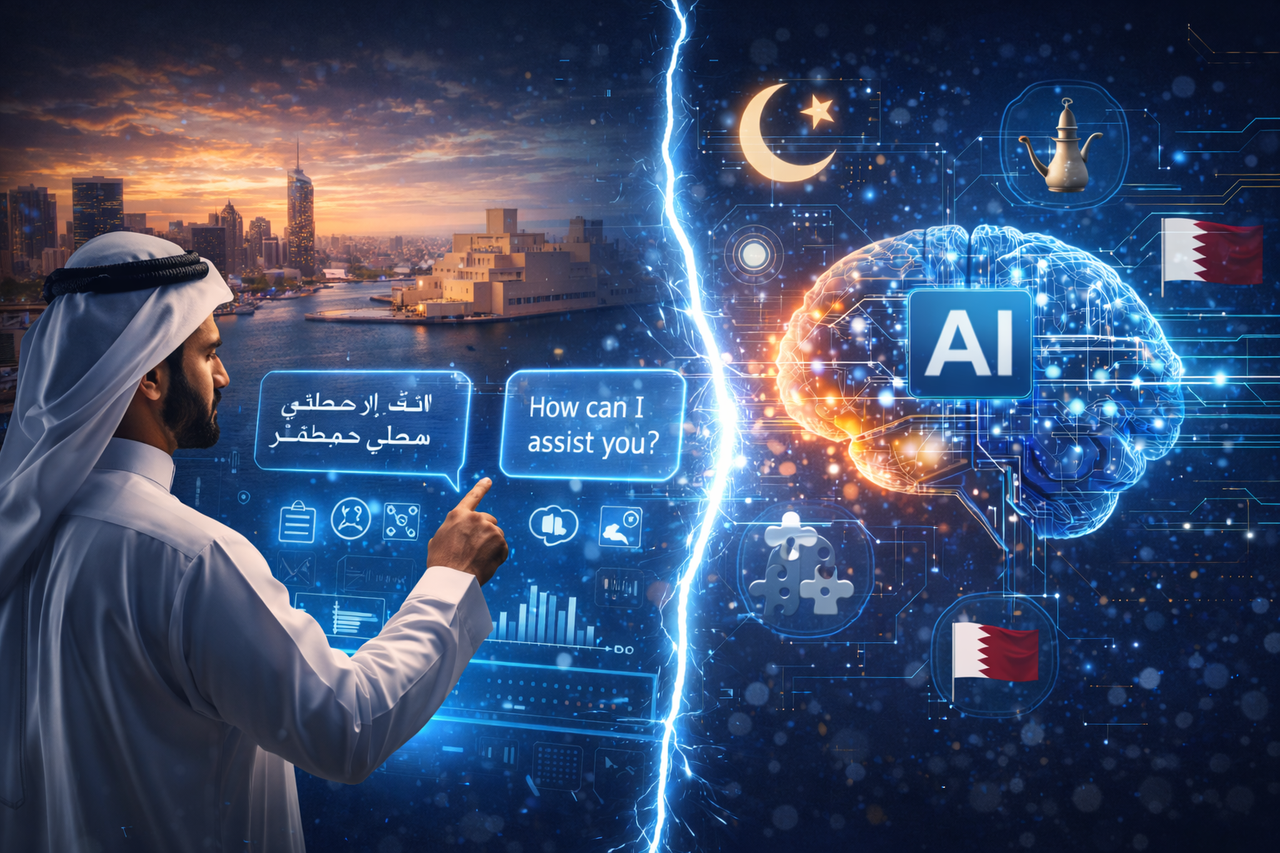
The Middle East is no longer just a consumer of technology; it is becoming a primary innovator. With initiatives like the Qatar National Vision 2030, the region is investing heavily in the infrastructure required to support massive AI workloads.
For local enterprises, this presents a unique opportunity. Working with an Expert Artificial Intelligence Studio in Doha allows businesses to build tools that are natively bilingual, culturally aware, and optimized for the specific regulatory environment of the GCC. This localized intelligence is something global "one-size-fits-all" platforms simply cannot replicate.
Overcoming the "Black Box" Challenge
One of the biggest hurdles to AI adoption is the "Black Box" problem—the difficulty of understanding how an AI reached a specific conclusion. To gain stakeholder trust, modern systems must prioritize:
- Explainable AI (XAI): Building models that can provide a clear rationale for their decisions.
- Ethical Guardrails: Ensuring that automated systems do not inadvertently discriminate or violate privacy.
- Continuous Feedback Loops: Allowing human experts to "train the trainer," refining the AI's accuracy over time.
The Future of Human-Machine Collaboration
The goal of Cognitive Computing Solutions is not to replace humans, but to augment them. By handling the "drudge work" of data analysis and pattern recognition, AI frees human workers to focus on creativity, empathy, and high-level strategy.
In healthcare, for example, Computer Vision Security Tools and diagnostic AI allow doctors to spend less time on paperwork and more time with patients. In education, personalized AI tutors adapt to a student's learning pace, ensuring no child is left behind.
Frequently Asked Questions (FAQ)
Q: What is the difference between standard automation and Smart Process Automation?
A: Standard automation follows a "if this, then that" logic. It is rigid. Smart Process Automation uses machine learning to make decisions. If a situation changes, the AI adapts its behavior without needing a human to rewrite the code.
Q: Why should I choose a custom-built model over a public AI like GPT-4?
A: Public models are trained on general data. A custom model is trained on your proprietary data. This ensures higher accuracy, better security for your trade secrets, and a solution that is perfectly aligned with your specific business goals.
Q: How secure is Optical Identity Verification?
A: It is significantly more secure than traditional methods. Modern Advanced Biometric Verification Systems use 3D mapping and liveness detection to prevent "spoofing" (using a photo or video to trick the system). It is currently the gold standard for high-security access.
Q: Is AI implementation only for large corporations?
A: Absolutely not. While the scale differs, small and medium enterprises (SMEs) can gain massive efficiency by using Cognitive Computing Solutions for customer service, inventory management, and targeted marketing.
Q: How does an AI-native approach help with sustainability?
A: AI is a powerful tool for ESG goals. It can optimize energy consumption in buildings, reduce waste in manufacturing, and streamline logistics to lower carbon footprints.
The Path Forward: Transforming Vision into Reality
The landscape of business has changed forever. The alliance between G42 and Publicis Sapient is just the beginning of a global wave of AI-driven industrialization. To remain relevant, your organization must transition from being a passive observer to an active participant in the AI revolution.
At Hyena.ai, we don't just build software; we build the future. Our team of world-class engineers and data scientists specializes in crafting bespoke Cognitive Computing Solutions that drive real-world results. Whether you are looking to secure your digital borders with Optical Identity Verification or revolutionize your operations with Smart Process Automation, we have the expertise to make it happen.
We have empowered global leaders to shed their legacy constraints and embrace the power of the machine. From high-growth startups to established giants, our mission is to ensure that every partner we work with becomes a leader in the AI-first economy.
Start Your Journey with Hyena.ai Today – Schedule Your Strategy Session